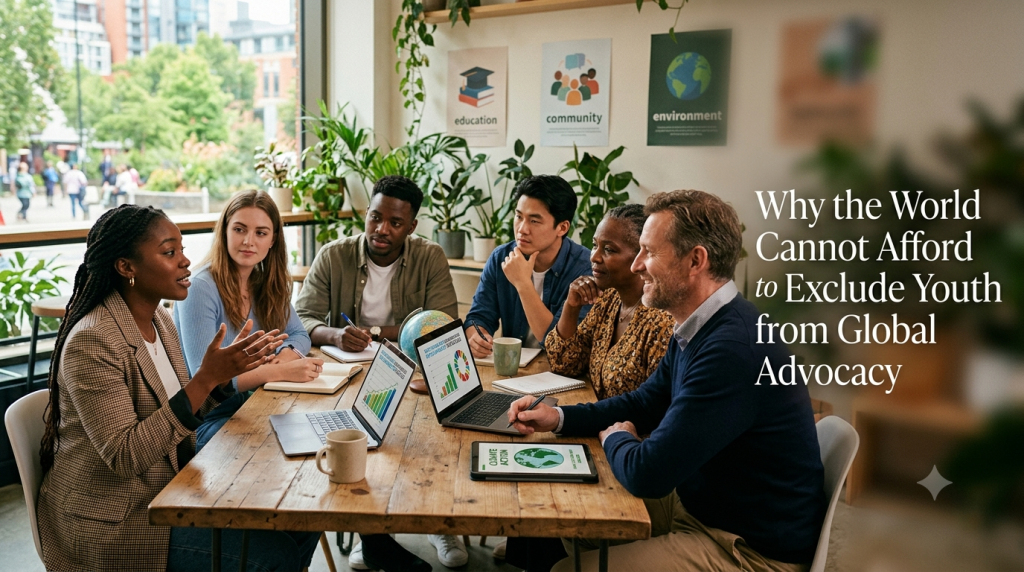
Imagine sitting in a room where decisions about your future are being made, but no one in the room looks like you.
This is still the reality for many young people around the world.
There are about 1.2 billion people between the ages of 15 and 24 today, making up roughly 16% of the world’s population. When we consider everyone under 30, young people make up about half of humanity. Yet, their presence in the rooms where important decisions are made remains limited.
This matters because the decisions being made today will shape the world young people inherit tomorrow.
Climate change, education, unemployment, conflict, technology and inequality are not distant issues for young people. They are part of the world they are growing up in. So why should they have little say in shaping the solutions?
Young People See Things Differently
Young people are coming of age during a period of rapid change.
They have watched technology transform how we communicate, learn and work. They are also growing up with challenges such as misinformation, online safety, limited access to digital tools and an uncertain job market.
Climate change is another example. Young people are likely to live with the consequences of today’s environmental decisions for decades. Around the world, young activists have helped bring greater public attention to climate change and pushed leaders to take the issue more seriously.
But the value of youth participation is not simply that young people are “innovative” or “good with technology.” Young people are not all the same. A young person living in rural Nigeria may experience climate change, education or unemployment very differently from a young person in London or New York.
That diversity is exactly why their voices matter.

Beyond the Photo Opportunity
For a long time, youth participation in international spaces could sometimes feel more symbolic than meaningful. Young people might be invited to attend a conference, give a speech or participate in a side event, while the major decisions were still being made elsewhere.
There are now efforts to change this.
The United Nations Youth Delegate Programme, for example, allows Member States to include young people in their official delegations to UN meetings. Depending on their country’s mandate, youth delegates can attend meetings and negotiations, contribute to their delegations’ work and provide input on issues affecting young people.
The World Economic Forum’s Global Shapers Community is another example. It brings together young people around the world and supports projects addressing issues such as climate action, education, economic opportunity and social inclusion.
These initiatives are important. But inviting young people into a room is only the beginning. Meaningful participation means allowing them to contribute to discussions, influence decisions and have access to the people who hold power.
They Will Live With the Consequences
Think about a decision made today about education, the environment or technology.
It may seem like a policy for the present, but its effects could last for decades. The young people who are 20 today may still be living with those consequences when they are 50. This is why youth participation matters.
It does not mean young people always have the right answer. It simply means that people who will live longest with the consequences of today’s decisions should have a place in shaping those decisions. Unfortunately, getting into those spaces is not always easy.
Travel, visa fees, accommodation and registration costs can make international conferences inaccessible to young advocates, especially those from low-income communities and countries in the Global South. There is also a representation problem closer to home. According to the Inter-Parliamentary Union, only 2.8% of parliamentarians worldwide are aged 30 or under.
So even where young people are invited to global conversations, many have limited access to the political structures that influence those conversations.
What Can We Do Differently?
This is where civil society organisations have an important role to play.
NGOs cannot demand that governments listen to young people while keeping young people out of their own decision-making spaces.
We need to do more than ask young people to volunteer or attend events. We need to give them opportunities to contribute to research, programme design, advocacy and community work. We need to invest in mentorship and leadership development. And where possible, we need to create clear pathways for young people to move from participation to leadership.
For organisations working directly with communities, this is especially important.
Young people are already solving problems around them. They organise, volunteer, create businesses, use technology, advocate for their communities and speak up about issues that affect their lives. Sometimes, what they need is not another person to speak for them. They need someone willing to make room for them to speak for themselves.
Making Room at the Table
Youth inclusion should be more than a conference invitation or a photograph. It should mean giving young people the opportunity to influence the decisions that affect their lives. The world cannot afford to make decisions about the future while leaving a large part of that future outside the room.
At TWHAHF, we believe that meaningful change begins when people are given the opportunity to participate in shaping the solutions that affect their lives. Young people are not simply beneficiaries of tomorrow’s world, they are already helping to build it. We need to make sure they have a seat at the table and that’s the reason for TWHAHF Global Advocacy. Be a part of shaping the future today. Click here