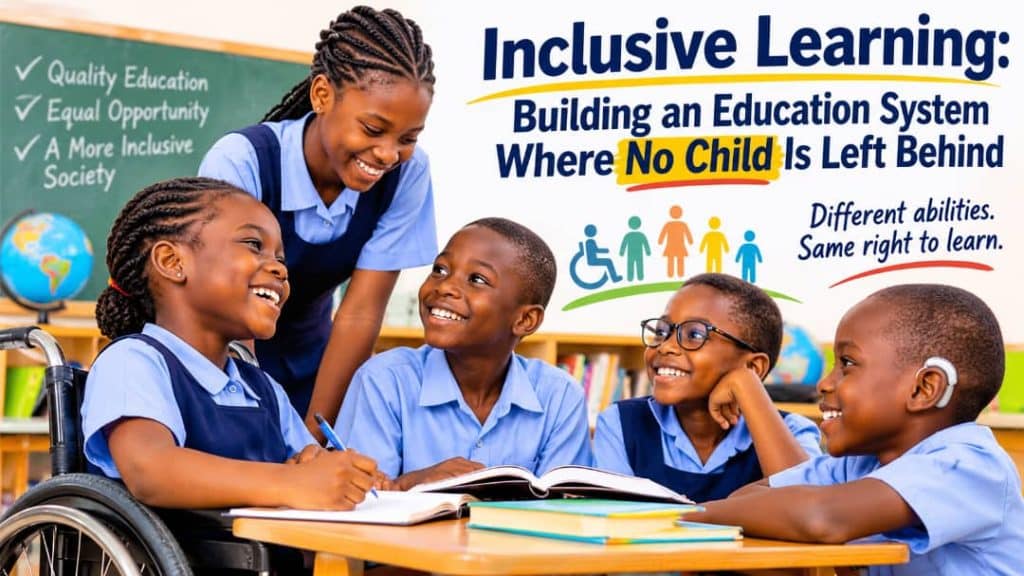
Inclusive learning is an approach to education that recognises and accommodates the diverse needs, abilities, backgrounds and circumstances of learners. It seeks to create learning environments where every child has a fair opportunity to participate, understand, develop and achieve their potential, regardless of their individual differences.
Although inclusive learning is frequently discussed in relation to children with disabilities, its scope is considerably broader. It also considers children from disadvantaged socioeconomic backgrounds, linguistic minorities, displaced populations, children experiencing emotional or psychological difficulties and those who learn at a different pace from their peers.
According to UNESCO, inclusive education involves identifying and removing barriers to education. These barriers may exist in school policies, teaching methods, curricula, learning materials, physical infrastructure and even societal attitudes. The underlying principle is that the education system should adapt to the learner, rather than expecting every learner to fit into a rigid educational structure.
What Are Global Organisations Saying?
The importance of inclusive learning is reflected in the positions of some of the world’s leading international organisations.
UNESCO places inclusion and equity at the centre of its education agenda, particularly through Sustainable Development Goal 4 (SDG 4), which calls for inclusive and equitable quality education and lifelong learning opportunities for all. Its position is that educational exclusion cannot be addressed simply by increasing school enrolment. Education systems must also identify the different circumstances preventing learners from participating and benefiting fully from education.
In its 2020 Global Education Monitoring Report, titled Inclusion and Education: All Means All, UNESCO examined the different forms of exclusion affecting learners across the world. The report emphasised that a person’s gender, disability, ethnicity, language, social background or economic circumstances should not determine the quality of education they receive. Its central message is particularly significant: inclusion is not an additional consideration in education; it is fundamental to achieving quality education.
Similarly, the United Nations Children’s Fund (UNICEF) considers inclusive education essential to ensuring that every child has an opportunity to learn and develop the skills needed to thrive. According to UNICEF, inclusive education means children from different backgrounds and with different abilities learning together in the same classrooms and schools, with appropriate support.
Its inclusive education programme highlights the need for trained teachers, accessible learning materials, improved school infrastructure and deliberate efforts to address discrimination and stigma within communities.
UNICEF’s position is particularly important because it shifts the conversation from simply allowing children into classrooms to ensuring that they can meaningfully participate once they get there.
The World Bank also recognises inclusive education as essential to sustainable human development. In its 2025 publication on inclusive education, the organisation explains that learners may experience multiple, overlapping disadvantages. For instance, a child with a disability living in a poor rural community may encounter considerably more barriers than a child facing only one of these circumstances.
The World Bank advocates for systemic educational reforms, including teacher development, accessible learning environments, appropriate curricula, flexible assessment methods and targeted support for learners who require additional assistance.
Its argument is that educational inequality cannot be adequately addressed without considering the different barriers that prevent learners from accessing and benefiting from education.
The Nigerian Context: Policy Versus Practice
For Nigeria, inclusive learning is not an entirely new concept. The country has made policy commitments towards ensuring that children with different educational needs have access to quality education.
The Federal Ministry of Education’s National Policy on Inclusive Education in Nigeria (2021) recognises the importance of creating an educational system that accommodates diverse learners. It identifies groups requiring particular attention, including children with disabilities, children living in poverty, out-of-school children, linguistic minorities and learners experiencing temporary learning difficulties.
The policy provides an important foundation for addressing educational exclusion. However, having a policy is only one part of the process. Its effectiveness depends on implementation, adequate funding, institutional commitment and the capacity of schools and teachers to translate its provisions into practical interventions.
Some of the challenges remain visible in the everyday experiences of Nigerian learners. Schools may lack wheelchair-accessible facilities, appropriate learning materials for children with visual or hearing impairments, and teachers equipped to support learners with different educational needs. Social stigma and misconceptions about disabilities can further discourage parents from enrolling their children in mainstream schools.
Importantly, these challenges are not limited to disability. Children who struggle with reading, those who do not understand the language of instruction and those who cannot afford basic learning materials may also experience exclusion within the classroom.
Making Inclusive Learning a Reality
Achieving inclusive learning requires more than placing children with different abilities in the same classroom. It requires deliberate changes in how education is designed, delivered and evaluated.
Teachers must receive appropriate training to identify different learning needs and employ teaching methods that accommodate diverse learners. Schools must invest in accessible infrastructure, assistive technologies and adaptable learning materials. Governments must also strengthen policy implementation, allocate adequate resources and establish monitoring systems to measure whether learners are actually benefiting from educational interventions.
Equally important is the involvement of parents, communities and organisations working with vulnerable populations. Their experiences and contributions can help identify barriers that may otherwise remain unnoticed.
A recent UNICEF global report published in June 2026, drawing on research across six countries, reinforces this position. Its findings demonstrate that exclusion is not inevitable and that education systems can become more responsive through sustained commitment, appropriate resources and reforms that recognise the needs of children with disabilities and learning differences.
Ultimately, inclusive learning is about recognising that children do not have to be identical to deserve equal educational opportunities. A child who learns differently is not less deserving of education. A child with a disability should not have to overcome an inaccessible system before being given the opportunity to learn.
The true measure of an effective education system should not be how well it serves children who already fit into its structure, but how deliberately it accommodates those who would otherwise be left behind.