Every morning across Nigeria, millions of children put on their uniforms, pick up their backpacks and head to school. Their parents wave them off with high hopes, believing that education will give their children a better future. But getting children into classrooms is only part of the story. A child can spend years in school and still leave without the reading, numeracy, problem-solving and other skills needed to succeed. This is the heart of what is often called the schooling-without-learning problem.
The World Bank describes this wider crisis through the concept of learning poverty: the inability to read and understand a simple text by age 10. In Sub-Saharan Africa, about 89 percent of children are estimated to be living in learning poverty. Nigeria faces the same challenge.
According to UNICEF, only 27 percent of children aged 7 to 14 have foundational reading skills, while only 25 percent have foundational numeracy skills. In other words, roughly three out of every four children in this age group lack these basic foundational skills. These figures remind us that access to school does not automatically lead to learning. If we want to improve education in Nigeria, we must pay close attention to what happens inside the classroom and to the people responsible for making learning happen.
The Teacher at the Heart of Learning
A school building does not educate a child on its own. Neither does a textbook or a syllabus.
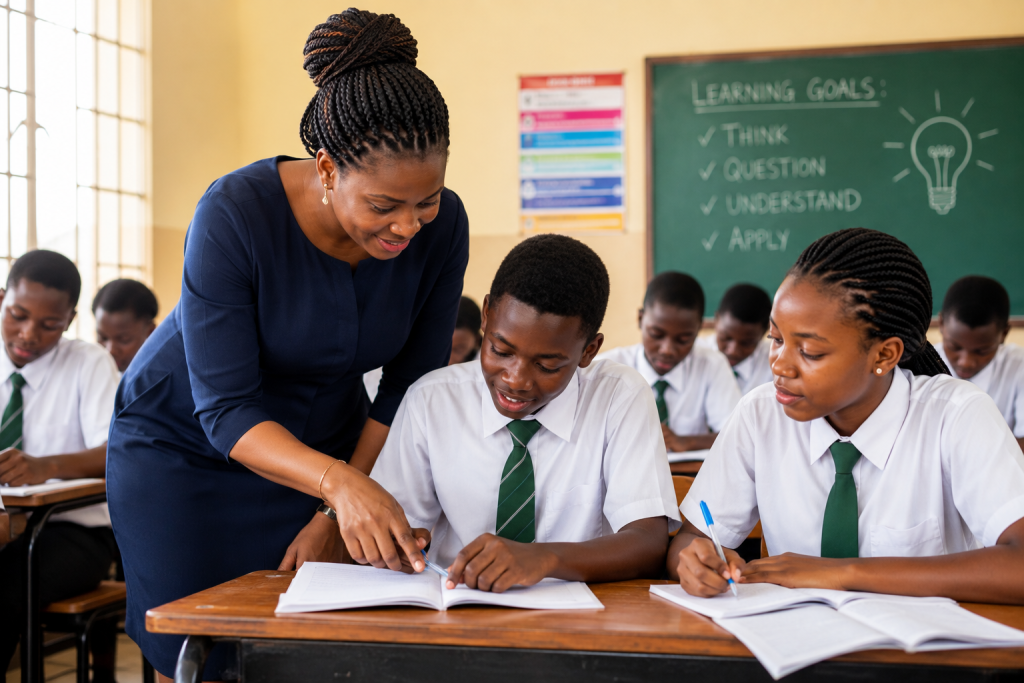
At the heart of classroom learning is the teacher standing in front of the students. Teachers are expected to explain difficult ideas, manage classrooms, assess learning, respond to different learning needs and keep students engaged. Yet many teachers work in challenging conditions and do not always have enough opportunities for practical, continuous professional development.
UNICEF identifies weak teacher capacity and insufficient opportunities for standardized teacher professional development as important challenges affecting Nigeria’s learning outcomes. This is why teacher development should not be treated as a one-time activity that ends when a teacher receives a qualification. Teachers, like professionals in other fields, need opportunities to keep learning, practising and improving.
Nigeria’s Learning Crisis Is Too Big to Ignore
The scale of the problem is also reflected in Nigeria’s human capital outcomes. The World Bank’s Human Capital Index gives Nigeria a score of 0.36. This means that, under current levels of health and education services, a child born in Nigeria can be expected to achieve only about 36 percent of the productivity they could have achieved with complete education and full health. This figure should concern all of us. It shows that the quality of education is not simply a classroom issue. It is connected to Nigeria’s future workforce, economic growth and ability to develop its human capital.
But these statistics should not be interpreted as a failure of Nigerian children. Children can learn when they have the right support and opportunities. The question is whether our education system is consistently giving teachers and learners the tools they need to succeed.
Recent national assessment data reinforce the need for improvement. The National Assessment of Learning Achievement in Basic Education (NALABE) 2022 assessed more than 160,000 learners across Primary 3, Primary 5 and Junior Secondary 2 in schools across all 36 states and the Federal Capital Territory. The assessment was designed not only to measure learning but also to examine the conditions in which learning takes place.
From Teaching the Syllabus to Supporting Real Learning
One important change we need is a shift from simply completing the syllabus to making sure students actually understand what they are being taught.
In some school environments, completing the scheme of work can receive more attention than checking what students have understood and retained. But covering a topic is not the same as teaching it successfully.
Continuous teacher development can help teachers use practical strategies that make learning more active. Instead of simply explaining facts and asking students to copy notes, teachers can use discussions, group activities, demonstrations, questions and real-life examples to help students connect ideas and apply what they have learned.
This does not mean abandoning the curriculum. It means teaching the curriculum in ways that help students understand and use the knowledge they acquire.
Supporting Teachers to Manage Real Classrooms
Teaching a large class is demanding. Teachers have to deal with different abilities, personalities, learning needs and behavioural challenges, often at the same time.
National assessment data show that teacher capacity and the conditions in which teachers work remain important areas for improvement. UNICEF’s recent work on teacher development in Nigeria specifically highlights the need for stronger, practical and school-based professional development. Professional development can give teachers practical tools for classroom management, positive behaviour support, inclusive teaching and student engagement.
When teachers understand how to create a respectful and supportive classroom, students are more likely to feel comfortable asking questions, making mistakes and participating in lessons. A classroom should not be a place where students are afraid to get an answer wrong. It should be a place where they are encouraged to learn from mistakes.
Bringing Technology into the Classroom
Technology is another area where continuous teacher development can make a difference.
We are living in a digital age, but access to technology remains uneven across Nigeria. This does not mean that every classroom needs expensive computers, smartboards or high-speed internet. Sometimes, simple digital tools can make lessons more engaging. Teachers can use videos, digital presentations, educational apps, online resources or even offline learning materials where internet access is limited.
Nigeria already has an example of how technology can be adapted to different learning environments. The Nigeria Learning Passport, developed by UNICEF and the Federal Ministry of Education, provides online, mobile and offline learning resources for learners, teachers and parents, including resources designed for areas without reliable internet access. Teacher training is therefore not only about showing educators how to use technology. It is about helping them understand when and how technology can make learning more effective.
Qualifications Matter, but So Does Continuous Development
Teacher qualification is another important part of the conversation .The NALABE 2022 assessment found that 91 percent of primary school teachers and 87 percent of junior secondary school teachers surveyed had a teaching qualification. The report also noted the need to upgrade teachers without professional teaching qualifications. This shows why the conversation should go beyond simply asking whether a teacher is qualified.
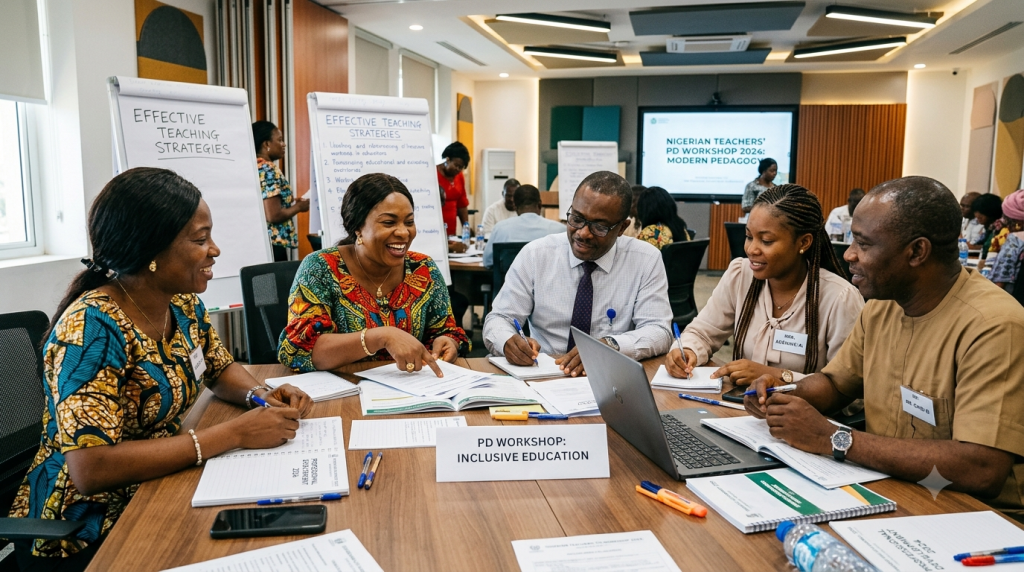
A qualification provides an important foundation, but teaching is a profession that requires continuous growth. Academic knowledge does not automatically teach someone how to manage a classroom, explain difficult concepts clearly, assess learning or respond to students with different needs.
Teachers therefore need opportunities to keep developing these practical skills throughout their careers. This is particularly important in areas where teachers may have entered the profession without the minimum qualification. In north-east Nigeria, for example, UNICEF has supported programmes that provided additional training and certification to thousands of teachers who were already working in schools without the required teaching qualifications.
Teacher Development Is an Investment in Every Child
When we invest in a teacher, we are not investing in only one person.A well-trained teacher can influence the learning of successive groups of students over many years. This makes teacher development an important part of building a stronger and more sustainable education system.
Of course, teacher training alone cannot solve every problem in Nigerian education. We also need better infrastructure, adequate learning materials, stronger school leadership, safe learning environments, effective policies and greater attention to the needs of disadvantaged children.
But improving teaching must remain an important part of that wider reform. UNICEF’s work on teacher development in Nigeria shows that school-based professional development can be used to strengthen teaching effectiveness and improve student learning. The goal should therefore not be to organise occasional workshops simply because a training activity appears on a calendar. The goal should be to create a culture where teachers continuously learn, practise, receive feedback and improve.
Reimagining the Nigerian Classroom
Nigeria cannot continue to demand twenty-first-century skills from students while giving teachers limited opportunities to develop the skills needed to teach for the twenty-first century.
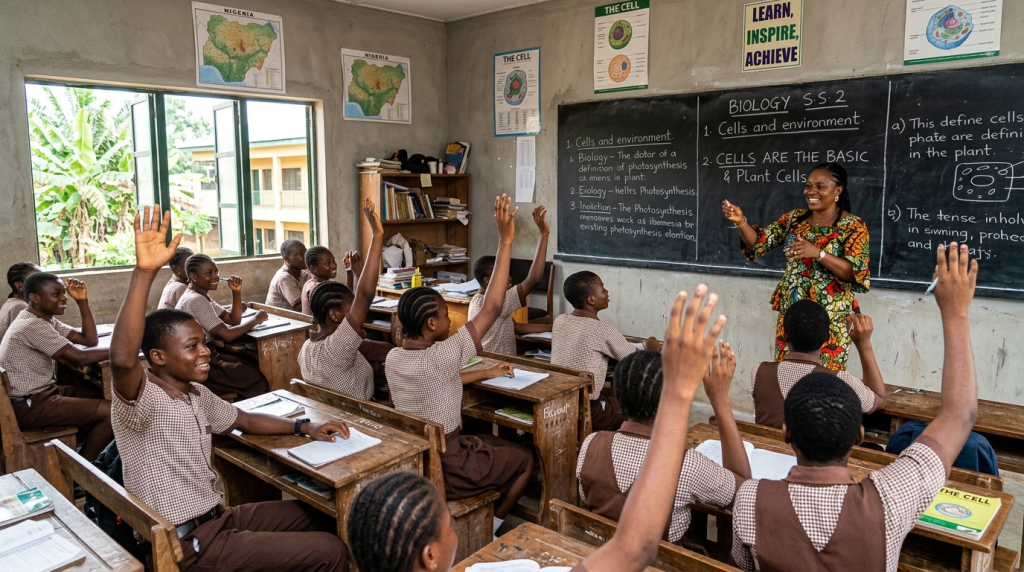
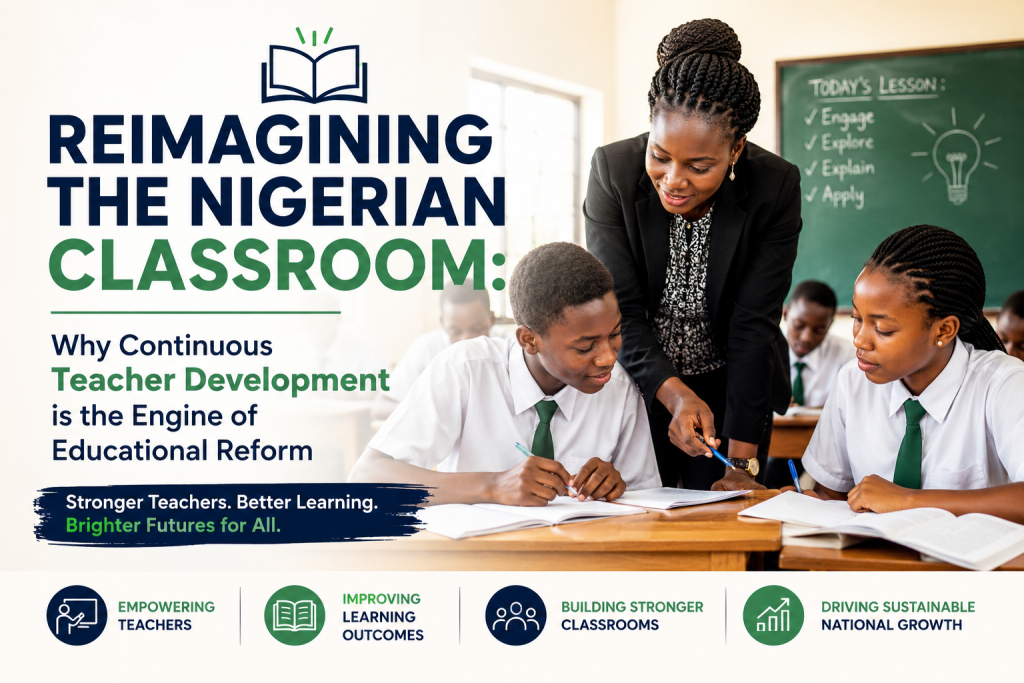
Our teachers deserve more than occasional seminars. They need practical, relevant and continuous professional development that responds to the realities of their classrooms. They need modern teaching strategies, classroom-management tools, assessment skills, digital literacy and opportunities to learn from one another.Most importantly, they need support.
If we want Nigerian children to move from simply attending school to actually learning, we must invest in the people who make learning possible every day.By investing in continuous teacher development, we are not simply improving individual classrooms. We are strengthening the foundation on which Nigeria’s education system, and ultimately its human capital and future, depends.