

Every year, thousands of young Nigerians leave tertiary institutions with degrees, big dreams, and the hope that education will open doors to stable careers. But for many, the real struggle begins after graduation. The transition from the classroom to the workplace can be overwhelming. Young people spend months or even years searching for jobs, while employers continue to report difficulty finding candidates with the practical skills needed to succeed at work.
The problem is not a lack of intelligence, ambition, or resilience. It is the gap between what young people learn in school and what the workplace expects from them. One important thing missing in that gap is mentorship.
The Employability Gap
ActionAid Nigeria estimates that about 1.7 million young people graduate from tertiary institutions in Nigeria each year. Yet the formal economy cannot absorb all of them. Many are left navigating unemployment, informal work, poorly paid jobs, or prolonged job searches.
A widely cited Nigerian graduate-employment survey reported that 75% of new graduates earned less than ₦50,000 per month in their first job, while one in four earned less than ₦20,000. These figures highlight an important reality: a university degree no longer automatically translates into financial security. Part of the problem is employability. Many graduates leave school with academic knowledge but limited exposure to the practical skills required to apply that knowledge effectively at work.
Employers increasingly value clear communication, digital skills, problem-solving, emotional intelligence, professionalism, adaptability, and the ability to work effectively with others. These are skills that are difficult to learn from textbooks alone. This is where mentorship can make a difference.
More Than Career Advice: The Confidence Problem
There is another side to this challenge that employment statistics do not fully capture: confidence. Recent global research from Mentorloop found that Gen Z’s confidence in their ability to achieve their five-year career goals fell from 59% to 39%. This is not a Nigeria-specific statistic, but it reflects a wider challenge facing young professionals: entering an increasingly uncertain world of work without always having the guidance they need.
A young graduate may have the qualification and still wonder: Should I accept this job? How much should I be earning? How do I negotiate a better offer? How do I build a professional network? Am I on the right career path? How do I handle a difficult workplace?
These are questions a university degree does not necessarily answer. Without guidance, many young professionals learn through trial and error. Some make avoidable mistakes, lose confidence, burn out, change jobs repeatedly, or settle for opportunities far below their potential. Mentorship can shorten that learning curve.

What Do We Mean by Structural Mentorship?
Mentorship should be more than occasionally connecting a young person with an experienced professional and hoping they figure things out. By structural mentorship, we mean an organised system that intentionally connects students and early-career professionals with experienced professionals through clear goals, regular interaction, accountability, feedback, and measurable outcomes.
The goal is not to create dependence. It is to help young people develop the knowledge, skills, confidence, networks, and decision-making ability they need to navigate their careers more effectively. A good mentor does not simply say, “You can do it.” A good mentor can show a young person how to do it.
Why Mentorship Works
Nigeria does not have to figure this out from scratch. Research from other parts of the world has found positive outcomes associated with structured mentoring programmes.
A five-year study involving employees at Sun Microsystems found that employees who participated in mentoring were promoted five times more often than those who did not. The study also found that 25% of mentored employees advanced a salary grade, compared with 5% of employees who were not in the mentoring programme
These findings do not mean that mentorship automatically guarantees promotion or higher pay. They suggest that access to experienced guidance can help employees understand workplace expectations, develop professionally, and navigate career progression more effectively. A mentor can help a young professional prepare for interviews, improve workplace communication, identify useful skills, understand industry expectations, build professional relationships, and recognise opportunities they might otherwise miss.
Mentorship Also Helps People Stay
Getting a job is only the beginning. Keeping it, growing in it, and finding satisfaction in it matter too.
The Sun Microsystems study reported 72% retention among mentored employees compared with 49% among those who did not participate in the programme. Similarly, in a CNBC/SurveyMonkey workplace survey, 91% of workers who had a workplace mentor said they were satisfied with their jobs, compared with 79% of workers without a mentor.
Starting a career can be lonely. Having someone who understands the journey can make the workplace less intimidating. A mentor provides a safe space to ask questions, discuss challenges, receive honest feedback, and make better decisions. For employers, this can contribute to better retention. For young professionals, it can mean greater confidence, direction, and a stronger sense of belonging.
The Power of Professional Networks
Mentorship can also provide something academic institutions often cannot: access to people and opportunities.
Sometimes, getting the right opportunity is not only about what you know. It is also about who knows you, who can recommend you, and who can point you towards an opportunity. In a Nigerian graduate survey, personal contacts were reported as a much more common route to employment than university or polytechnic channels.
A mentor can help a young person build this kind of professional network by making introductions, sharing industry knowledge, recommending resources, providing professional references, and helping them understand how their chosen industry works. Sometimes, one conversation with the right person can save a young professional years of confusion.
The Gap We Need to Close
Nigeria has millions of young people who are educated, ambitious, and eager to work. Employers, meanwhile, are looking for people who can apply their knowledge, adapt quickly, communicate effectively, and contribute meaningfully. So, it is important not to oversell what mentorship can do. A mentor cannot create a job where there is none. Mentorship cannot replace job creation, economic reform, improvements in education, or better labour-market policies. Nigeria’s employment challenges are structural and require structural solutions.
What mentorship can do is help young people become better prepared for available opportunities, navigate the labour market more effectively, avoid preventable mistakes, and gain access to knowledge and networks that are often difficult to acquire in isolation.
That makes it a practical and potentially high-impact part of a broader solution.
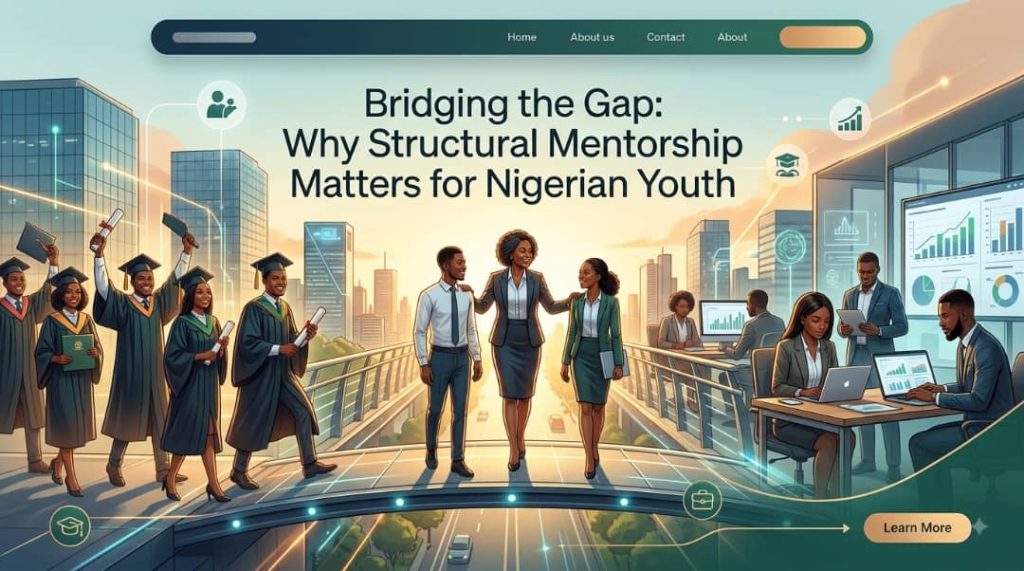
Building the Bridge Together
Nigeria does not have a shortage of young people with potential. What many young people lack is access to people who can help them turn that potential into something tangible. This is why we believe structured mentorship should be more than a nice addition to youth development programmes. It should be part of how we prepare young Nigerians for the world of work.
Imagine young people learning how to communicate professionally, build networks, negotiate opportunities, navigate difficult workplaces, and position themselves for growth before they have to learn everything the hard way.
That is the kind of bridge we need to build and building it will require all of us. Industry professionals can give their time and experience. Companies can invest in mentorship and professional development. Educational institutions can create stronger links between students and the world of work. Development organisations can build structured, evidence-based programmes that connect young people with the right mentors.
The challenge is real, but so is the opportunity.
Nigeria’s young people already have the talent and ambition. What they need is the guidance, access, and support to turn both into opportunity.